


Charity Digital Campaign Presentation with Speaker Notes
- Joe Carrick-Lawson
- Jan 24, 2024
- 12 min read

This is a fictional example of a digital campaign a charity can use to raise awareness and increase donations. I chose "Shout", a mental health charity that prioritises a text-based service.

Hello, we are Satin Squares Digital, and today we will be presenting our idea for our “Shout with the 1%” digital campaign for Shout UK. This will involve a series of advertisements for social media, showing the different percentages of people with mental health conditions, and those that have used the service. This will be done in an easy to quantify and engaging way, using cartoon people in various scenarios.

Throughout this marketing proposal, we will be using Dave Chaffey and PR Smith’s SOSTAC (2013) model to explore the current issues and future goals for this campaign. Firstly, we will be performing a situational analysis to determine the current effect of mental health, the current reach of Shout, and the current statistics of your competitors in similar mental health services. Secondly, we will discuss the objectives we aim to achieve through this campaign. Specifically, this is raising awareness for the cause and the charity as well as increasing those interacting with shout, either for advice, as volunteers, or to donate. Thirdly, we will detail the strategy through the campaign that we propose. Fourthly, we will explain the tactics we will employ to reach more people, convert people into supporting the cause, and ensure they remain engaged consumers who will implore others to do the same. Finally, we will evaluate our strategy and illustrate how to measure the effectiveness of the campaign.

As we can infer from this table on the left, mental health is more prevalent than many assume. 1 in 50 people are diagnosed with notable problems such as Bipolar, and 1 in 15 people attempting suicide during their lifetime. As well as this, every week 1 in 17 people report having symptoms of anxiety, 1 in 25 report symptoms of PTSD, and 1 in 33 report symptoms of depression. This is a significant amount. Although it is also important to note this is only what the individual reports and is diagnosed with, so the number is likely higher in all cases.
The reasons as to why not everyone reports mental health, and specifically do not use mental health services, are displayed in the graph on the right. The most common factors are money, believing one can deal with it by themselves, and a lack of information on where to go. Other noteworthy factors include time, and concerns on how one may be negatively treated, either by the service or by others if the information is revealed. Aside from concerns around cost and confidentiality, all these issues have risen between 2008 and 2018, showing the hesitation that was apparent when Shout was first introduced.
Shout is useful at quelling some of these reasons, as it is a free service that can be messaged whenever without a set time and is protected on one’s personal device. However, many do not know it exists, and are uncertain whether they need help due to the stigmas discussed, hence there is a demand for a useful marketing campaign.

Regarding Shout’s current statistics in an eSWOT analysis, it is apparent that Shout does have multiple strengths. Firstly, it has a presence on social media, primarily Instagram, as well as Facebook, and TikTok. Secondly, approximately 1% of the UK population has used the service, which although seeming comparatively low to the 99% who haven’t, it is still a notable achievement and the primary focus of this campaign.
Although there are also some weaknesses. Shout’s current posts aren’t reaching a wider audience, primarily on TikTok which has a rather low impression rate. Also, there has not been much growth in the profiles over the last few months (Social Blade, 2023). This may be because of the threats to mental health services, namely the reasons as to why people are not using them. Also, many people, especially older generations, prefer in-person conversations.
However, these threats offer opportunities, as there is space in mental health services for a text-based service that appeals to generations who already use social media. Apps such as Instagram and Facebook are primarily encouraged as a messaging service, as well as sharing photos, so those that use these apps are more familiar with this form of communication. As well as this, mental health advocacy on these sites have been increasing, such as with Mind’s “Time to Talk Day” (Mind, 2024b). Therefore, a larger presence on social media via digital marketing is vital to appeal to this demographic.

Comparing this to other mental health charities, particular Mind and Samaritans, it is evident that Shout has a notable presence in helplines and social media. This is especially true compared to the Samaritans on Instagram, as Shout posts more frequently and has 66% of the followers, despite not being as famous. As Instagram’s demographics are those between 18-35, this is likely the audience most familiar with the charity. Although, Shout is lacking in Facebook and TikTok, especially compared to Mind. Whereas Mind is more than just a helpline, having local spaces and shops as well, it also has a larger presence on social media due to its consistence in posts and variation in content. For example, whereas Shout’s TikTok generally features volunteer testimonials, Mind posts humorous content as well as testimonials and facts. This content is more engaging, increasing the “thumb-stopping” rate, and encouraging TikTok to create more impressions. By appealing to the algorithm and audience of TikTok, being younger people who enjoy sharing funny content, Mind has targeted a separate demographic compared to its Facebook and Instagram pages.

To ascertain what the key objectives are for this campaign, we are using Smith’s 5Ss model (Chaffey and Smith, 2017) to breakdown the key measures. Our most important objective is to speak to our audience to inspire conversations around mental health. This is followed by our goal to serve the audience by providing information about Shout and its benefits as a new and specialist alternative to other mental health services. By doing this, we aim to increase our brand identity and increase advocacy for Shout. This sizzle will be achieved using influencer testimonials and anonymous user feedback. In turn, this will be profitable as we encourage more support, volunteers, and donations. Finally, to maximise the effectiveness of the campaign in reach and profit, we aim to save costs by creating a unified cross-platform campaign using interchangeable statistics, graphics, and information to appeal to a wide range of demographics. This will create a universal message that is anchored to the Shout brand. It also means there is not a need for multiple smaller advertisements and posts that divide resources such as funds and employees.

Our proposed campaign will display this need to not feel alone and reduction of stigma by representing the percentages of people with mental health conditions in a tangible way. In the example on the left, we use a standard British pub, and on the right, a single London Underground carriage. On average, both contain about 100 people at full capacity. These are a recognisable iconography of British culture and concepts the audience can either recall being inside or has an idea of through film and TV which depict it. These graphics display a mix of people, from young and old, male and female, and other variations. Different people out of the 100 will then be highlighted to show the percentage of people, progressively building from a lower number of 2 (such as for Bipolar) to 20 to represent those with suicidal thoughts. This will then drop to the lowest number, of 1, which represents the percentage of those who have contacted Shout. To not assume that only specific conditions should contact shout, this person will not have been highlighted for anything else to leave their reasons ambiguous. Supporting text will include “You may not be in the majority, but the minority does not mean you are alone”, showing that in all cases, at least one other person also shared the condition, or there was a person to speak to. It will end with the hashtag “#shoutwiththe1%” and information to contact or research shout.
The video ad will be about 30 seconds to increase engagement though captivating graphics and a short time frame. It can be easily transferred to a static image showing multiple conditions highlighted at once, to be used on physical billboards or social media feeds. Also, it can be interchanged to other UK culture ideas, such as a playground to target parents and schools.

To evaluate our tactics, we will be segmenting the stages using the RACE model by Chaffey (2023). This is separated into Reach, Act, Convert, and Engage. The first stage, reach, involves building awareness and visibility. This can be further segmented using Gini Dietrich’s PESO model (2014), which separated paid, earned, shared, and owned media. In terms of paid media to create a zero moment of truth, we can use sponsored posts as native advertising on Facebook, Instagram, and TikTok, as well as ads on YouTube. This can be alongside a billboard and TV campaign to appeal to those over the age of 45 who are less likely to regularly use social media.
Furthermore, we can incorporate lead generation by having celebrity and influencer affiliates. Current advocates for Shout include Harry Kane, Roman Kemp, and Prince William. As well as these people, other British celebrities who already speak about their mental health could be approached. This can include Zayn Malik, Jade Thirwell, Cara Delevingne, Ellie Goulding, and Olly Alexander (BBC, 2017). By sponsoring famous people to repost the campaign, and perhaps add personal experiences that link to the campaign or to Shout, we will encourage a conversation with a wider and varied audience.
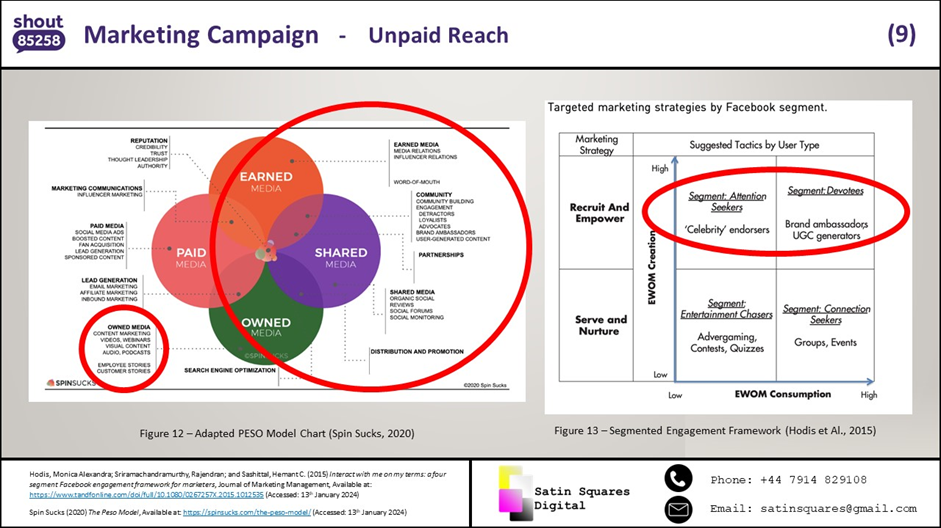
By advertising the campaign and creating discourse with celebrities, we aim to acquire earned media, particularly with influencers. In Monica Alexandra Hodis et Al’s engagement framework (2015), influencers are in the “attention seeker” segment. This is useful as they generate a high amount of electronic word of mouth by creating content based on popular trends, with an aim to recruit and empower. By creating a widespread campaign with celebrity endorsements, more influencers are likely to join the discussion to promote Shout. This leads to the “devotees” segment who are more likely to become long-term brand ambassadors even after the campaign has ended.
As well as this, Shout can continue its current strategies incorporating owned media such as volunteer testimonies and professional advice but encourage them to speak about the #shoutwiththe1% campaign. This creates authenticity and trust with audiences seeing the campaign promoted by real people and continues to appease audiences who already follow for such content.

The next stage is act, in which the audience takes steps to interact with the brand on their own accord. In order to encourage this, we can target people directly using various mental health percentages throughout the year, particularly around awareness days. Each advertisement will also feature the shout logo (which includes the phone number), social media links, and website links at the bottom throughout to guarantee people see the information. Furthermore, the end of the advert will directly encourage viewers to research more, donate, or message if they need help, as those that stay throughout the whole ad are more likely to be interested.
To convert people to being a repeat user, there will be omnichannel marketing with the various reach ideas previously mentioned, to keep people active and interested in the messages, information, and the cause. This is unlike the lack of engaging and regularly content Shout currently has. Furthermore, an increase in devotees can lead to the creation of a community involving both creators and audiences who are brand loyalists. This could become a forum site attached to Shout’s website. This allows for a safe space for people to talk about their mental health, with the option to do so anonymously, and allows for a second, less direct channel, for volunteers to give support, rather than one-on-one via text.

To keep people engaged with Shout, after our campaign has ended, we aim to continue with more volunteer, donator, and user stories on social media. Furthermore, the introduction of a monthly newsletter would be beneficial. This can contain information about donation and conversation milestones, what the money is used for, and upcoming mental health awareness days and events.

Finally, there are several key performance indicators to assess the success of our campaign. Firstly, we can use the social media apps to compare the number of likes, impressions, and followers received in comparison to the months prior to the campaign’s introduction. Secondly, we can monitor the popularity of the campaign hashtag #shoutwiththe1% and Shout’s general hashtag #giveusashout to observe the ubiquity of influences championing the charity. Thirdly, we can use Shout’s internal statistics to compare donations, volunteers, and users in the 2023/2024 report to the 2024/2025 report when this campaign will be active. Lastly, we can use feedback forms to compare annual satisfaction for volunteers and users, and encourage more advice on where to improve, to incorporate into future campaigns.
Overall, we expect our campaign to provide Shout with greater visibility online, and to raise awareness for mental health, and services that can help. Thank you for listening.
Bibliography
BBC (2017) 15 Celebrities get super real about their mental health issues, Available at: https://www.bbc.co.uk/programmes/articles/4cVPjcFly4TrNWq0XR5lmz7/15-celebrities-get-super-real-about-their-mental-health-issues (Accessed: 13th January 2024)
Chaffey, Dave and Smith, PR (2013) Emarketing excellence: planning and optimising your digital marketing, London and New York: Routledge
Chaffey, Dave and Smith, PR (2017) Digital Marketing Excellence, Planning, Optimising and Integrating Digital Marketing: Taylor & Francis
Chaffey, Dave (2023) Race Marketing Model, Available at: https://www.davechaffey.com/digital-marketing-glossary/race-marketing-planning-model/ (Accessed: 13th January 2024)
Conroy, Jessica; Lin, Luona; and Ghaness, Amrita (2020) Why people aren’t getting the care they need, American Psychology Association, Available at: https://www.apa.org/monitor/2020/07/datapoint-care (Accessed: 12th January 2024)
Dietrich, Gini (2014) Spin Sucks: Communication and Reputation Management in the Digital Age: Que
Facebook (2024a) @mind, Available at: https://www.facebook.com/mindforbettermentalhealth (Accessed: 11th January 2024)
Facebook (2024b) @samaritans, Available at: https://www.facebook.com/samaritanscharity (Accessed: 11th January 2024)
Facebook (2024c) @shout, Available at: https://www.facebook.com/giveusashoutuk (Accessed: 11th January 2024)
Hodis, Monica Alexandra; Sriramachandramurthy, Rajendran; and Sashittal,
Hemant C. (2015) Interact with me on my terms: a four segment Facebook engagement framework for marketers, Journal of Marketing Management, Available at: https://www.tandfonline.com/doi/full/10.1080/0267257X.2015.1012535 (Accessed: 13th January 2024)
Instagram (2024a) @mindcharity, Available at: https://www.instagram.com/mindcharity/ (Accessed: 11th January 2024)
Instagram (2024b) @samaritanscharity, Available at: https://www.instagram.com/samaritanscharity/ (Accessed: 11th January 2024)
Instagram (2024c) @giveusashoutinsta, Available at: https://www.instagram.com/giveusashoutinsta/ (Accessed: 11th January 2024)
Mind (2023a) Mind Annual Report and Accounts 2022/23, Available at: https://www.mind.org.uk/media/ntppvpjh/mind-annual-report-and-accounts-2022-to-2023.pdf (Accessed: 11th January 2024)
Mind (2023b) Mental Health Facts and Statistics, Available at: https://www.mind.org.uk/information-support/types-of-mental-health-problems/statistics-and-facts-about-mental-health/how-common-are-mental-health-problems/ (Accessed: 12th December 2023)
Mind (2024a) Helplines, Available at: https://www.mind.org.uk/information-support/helplines/ (Accessed: 11th January 2024)
Mind (2024b) Time to Talk Day, Available at: https://www.mind.org.uk/get-involved/time-to-talk-day-2024/#:~:text=Time%20to%20Talk%20Day%20is,want%20you%20to%20take%20part. (Accessed: 21st January 2024)
Samaritans (2023) Impact Report 2022/23, Available at: https://media.samaritans.org/documents/SamaritansImpactReport2022_23_WEB.pdf (Accessed: 11th January 2024)
Shout (2024) About Shout 84245, Available at: https://giveusashout.org/about-us/about-shout/ (Accessed: 11th January 2024)
Social Blade (2023) @giveusashoutinsta, Available at: https://socialblade.com/instagram/user/giveusashoutinsta (Accessed: 12th December 2023)
Spin Sucks (2020) The Peso Model, Available at: https://spinsucks.com/the-peso-model/ (Accessed: 13th January 2024)
Smart Insights (2024) The Smart Insights RACE Growth System, Available at: https://www.smartinsights.com/race-planning-framework/ (Accessed: 23rd January 2024)
TikTok (2024a) @mindcharity, Available at: https://www.tiktok.com/@mindcharity (Accessed: 11th January 2024)
TikTok (2024b) @giveusashout, Available at: https://www.tiktok.com/@giveusashout (Accessed: 11th January 2024)
Transport for London (2022) Northern line train graphics standard – Issue 2, Available at: https://content.tfl.gov.uk/northern-line-train-graphics-standard-issue-02.pdf (Accessed: 10th January 2024)
Figures
Mock-up of a Landing Page
Chart displaying the contents of the “Shout with the 1%” marketing campaign presentation
Table displaying Percentage of People in the UK with Mental Health Problems in their lifetime and per week (Mind, 2023b)
Mind (2023b) Mental Health Facts and Statistics, Available at: https://www.mind.org.uk/information-support/types-of-mental-health-problems/statistics-and-facts-about-mental-health/how-common-are-mental-health-problems/ (Accessed: 12th December 2023)
Graph showing reasons for not receiving mental health services in the past years, 2008 vs. 2018
Conroy, Jessica; Lin, Luona; and Ghaness, Amrita (2020) Why people aren’t getting the care they need, American Psychology Association, Available at: https://www.apa.org/monitor/2020/07/datapoint-care (Accessed: 12th January 2024)
Table showing Shout’s statistics at the end of 2023
Facebook (2024c) @shout, Available at: https://www.facebook.com/giveusashoutuk (Accessed: 11th January 2024)
Instagram (2024c) @giveusashoutinsta, Available at: https://www.instagram.com/giveusashoutinsta/ (Accessed: 11th January 2024)
Shout (2024) About Shout 84245, Available at: https://giveusashout.org/about-us/about-shout/ (Accessed: 11th January 2024)
TikTok (2024b) @giveusashout, Available at: https://www.tiktok.com/@giveusashout (Accessed: 11th January 2024)
SWOT analysis of Shout’s digital marketing
Table comparing Shout, Mind, and Samaritans helpline and social media statistics at the end of 2023
Facebook (2024a) @mind, Available at: https://www.facebook.com/mindforbettermentalhealth (Accessed: 11th January 2024)
Facebook (2024b) @samaritans, Available at: https://www.facebook.com/samaritanscharity (Accessed: 11th January 2024)
Instagram (2024a) @mindcharity, Available at: https://www.instagram.com/mindcharity/ (Accessed: 11th January 2024)
Instagram (2024b) @samaritanscharity, Available at: https://www.instagram.com/samaritanscharity/ (Accessed: 11th January 2024)
Mind (2023a) Mind Annual Report and Accounts 2022/23, Available at: https://www.mind.org.uk/media/ntppvpjh/mind-annual-report-and-accounts-2022-to-2023.pdf (Accessed: 11th January 2024)
Mind (2024) Helplines, Available at: https://www.mind.org.uk/information-support/helplines/ (Accessed: 11th January 2024)
Samaritans (2023) Impact Report 2022/23, Available at: https://media.samaritans.org/documents/SamaritansImpactReport2022_23_WEB.pdf (Accessed: 11th January 2024)
TikTok (2024a) @mindcharity, Available at: https://www.tiktok.com/@mindcharity (Accessed: 11th January 2024)
Graphic displaying Smith’s 5S Model applied to Shout’s digital marketing objectives (Chaffey and Smith, 2017)
Frame of an example social media portrait video advert (Instagram Reels layout)
Layout Image: Instagram (2024c) @giveusashoutinsta, Available at: https://www.instagram.com/giveusashoutinsta/ (Accessed: 11th January 2024)
“Tube” example of a social media 1:1 advertisement
Reference Image: Transport for London (2022) Northern line train graphics standard – Issue 2, Available at: https://content.tfl.gov.uk/northern-line-train-graphics-standard-issue-02.pdf (Accessed: 10th January 2024)
PESO Model Chart (Spin Sucks, 2020)
Spin Sucks (2020) The Peso Model, Available at: https://spinsucks.com/the-peso-model/ (Accessed: 13th January 2024)
PESO Model Chart (Spin Sucks, 2020)
Spin Sucks (2020) The Peso Model, Available at: https://spinsucks.com/the-peso-model/ (Accessed: 13th January 2024)
Customer Journey RACE Graph (adapted from Smart Insights (2024))
Smart Insights (2024) The Smart Insights RACE Growth System, Available at: https://www.smartinsights.com/race-planning-framework/ (Accessed: 23rd January 2024)
Customer Journey RACE Graph (adapted from Smart Insights (2024))
Smart Insights (2024) The Smart Insights RACE Growth System, Available at: https://www.smartinsights.com/race-planning-framework/ (Accessed: 23rd January 2024)
Segmented Engagement Framework (Hodis et Al., 2015)
Hodis, Monica Alexandra; Sriramachandramurthy, Rajendran; and Sashittal, Hemant C. (2015) Interact with me on my terms: a four segment Facebook engagement framework for marketers, Journal of Marketing Management, Available at: https://www.tandfonline.com/doi/full/10.1080/0267257X.2015.1012535 (Accessed: 13th January 2024)


Comments